More Than a Gua Sha Tool
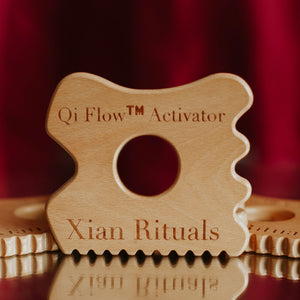
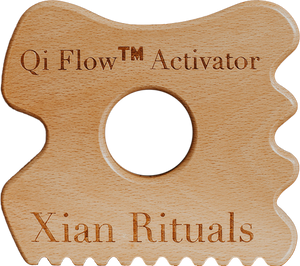
The Qi Flow™ Activator is a handcrafted wooden gua sha tool for the face and body, created for people who want more versatility than a traditional single-edge gua sha shape.
Its sculpted curves, rounded points, broad surfaces, and varied edges allow you to change how the tool meets the body. One area can be used for gentle facial sweeping, another for broader movements across the arms or legs, and another for focused, acupressure-style pressure.
Instead of reaching for several different massage tools, the Qi Flow™ Activator brings multiple techniques together in one substantial wooden form.
Use it as part of a morning ritual, an evening wind-down, or whenever you want a few intentional minutes to slow down and reconnect with your body.
One Tool. Multiple Ways to Use It.
The Qi Flow™ Activator can be used for:
- Facial and jaw massage
- Neck and shoulder massage
- Scalp massage
- Arms and legs
- Broad body sweeping movements
- Gua sha-inspired massage techniques
- Acupressure-style pressure
- Fascial and soft-tissue massage
- Areas that feel tight or overworked
- Relaxing, intentional self-care
The different contours let you adjust the way you work with each area rather than trying to use the same edge everywhere.
What Makes the Qi Flow™ Activator Different?
Many gua sha tools are relatively flat and provide only a few usable edges.
The Qi Flow™ Activator is purpose-shaped for both face and body use.
Its design gives you several different contact points within a single tool. You can move from a broader surface to a smaller curve or more focused point depending on the area you are working with and the sensation you prefer.
That makes it especially useful for someone who wants one gua sha tool that can move beyond a facial beauty routine and become part of a more complete self-massage ritual.
Designed for Face + Body
The face and body do not require the same approach.
For the face, jaw, and neck, the Qi Flow™ Activator can be used with lighter pressure and slow, controlled movements.
For larger areas of the body, its broader surfaces make it possible to use longer sweeping movements across areas such as the arms and legs.
The smaller curves and rounded portions can also be used when you want more focused contact.
Pressure should always be adjusted to the area and to your own comfort.
How Do You Use the Qi Flow™ Activator?
There is no need to turn your ritual into a complicated routine.
Apply an appropriate facial or body oil, serum, or other product that provides enough slip for the tool to move comfortably across the skin. Hold the Qi Flow™ Activator securely and use slow, deliberate movements rather than rushing.
On the face, use gentle pressure.
On broader areas of the body, pressure can be adjusted according to your comfort and the type of movement you are using.
Experiment with the different edges and contours. Part of the design is discovering which portion of the tool feels most natural for different parts of your face and body.
A few focused minutes can be enough to create a meaningful ritual.
Can I Use the Qi Flow™ Activator on My Face?
Yes.
The Qi Flow™ Activator can be used as a wooden facial gua sha and massage tool for areas including the cheeks, jawline, forehead, and other appropriate areas of the face.
Facial skin should be treated gently. Use light pressure, make sure the skin has adequate slip, and avoid aggressive scraping.
The goal is not to press harder. It is to use controlled, comfortable movement.
Can I Use It on My Jaw?
Yes.
The shape of the Qi Flow™ Activator makes it well suited to incorporating jaw massage into your ritual.
Many people naturally hold tightness around the jaw, particularly after long days spent concentrating, talking, driving, or sitting in front of a screen.
Working slowly around the jaw can simply become another opportunity to notice where you are holding unnecessary effort and spend a little time there.
Can I Use It on My Neck and Shoulders?
The Qi Flow™ Activator is designed for body use as well as facial use.
Its different edges can be used for slow massage and gua sha-inspired movements around appropriate areas of the neck and shoulders, while the broader portions of the tool provide more surface contact than a small facial gua sha tool.
Use only comfortable pressure and avoid applying pressure directly over the front of the throat or other sensitive structures.
Can I Use It on My Scalp?
Yes. The rounded portions of the Qi Flow™ Activator can also be incorporated into a gentle scalp massage ritual.
Use comfortable pressure and slow movements rather than scratching or dragging aggressively across the scalp.
It can be especially pleasant as part of an evening wind-down or after a long day.
Can I Use It on My Arms and Legs?
Yes.
One reason the Qi Flow™ Activator was designed as a face and body gua sha tool is that many smaller facial tools become awkward when used over larger areas.
The broader surfaces of the Activator make it easier to use longer sweeping movements across appropriate areas of the arms and legs.
You can then switch to another contour when you want more focused contact.
What Is Gua Sha?
Gua sha is a traditional East Asian bodywork practice that involves using a smooth-edged tool with repeated strokes across areas of the body.
It has a long history within Traditional Chinese Medicine and related East Asian healing traditions.
Modern facial gua sha practices are generally much gentler than traditional body gua sha. That distinction matters. Facial use should involve light, comfortable pressure rather than attempting to reproduce the stronger techniques traditionally used on the body.
The Qi Flow™ Activator draws inspiration from this history while adapting the tool into a versatile form intended for modern personal ritual and self-massage.
Rooted in Traditional Chinese Medicine
At Xian Rituals, gua sha is not approached simply as another beauty trend.
Traditional Chinese Medicine has long viewed hands-on practices as one way of engaging intentionally with the body. The Qi Flow™ Activator takes inspiration from that tradition while making the practice accessible within everyday life.
You do not need an elaborate routine.
Sometimes the ritual is simply noticing.
Your jaw is tight.
Your shoulders have crept upward.
You have been staring at a screen for three hours.
Or you have reached the end of the day and would rather spend five quiet minutes with a massage tool than another five minutes scrolling.
The Activator gives those few minutes a purpose.
Is the Qi Flow™ Activator Good for Beginners?
Yes.
You do not need previous gua sha experience to begin using the Qi Flow™ Activator.
Start simply. Choose one area, use gentle pressure, and become familiar with how the different contours feel in your hand and against your skin.
There is no prize for using every edge during one session.
As you become more comfortable with the tool, you can gradually explore different movements and areas of the body.
Why Choose a Wooden Gua Sha Tool?
Wood gives the Qi Flow™ Activator a warm, substantial feel in the hand and allows its sculpted design to function as both a facial and body massage tool.
Unlike a small flat stone intended primarily for facial use, the Activator's dimensional form provides multiple surfaces and contact points within one tool.
It is designed to feel like an object you reach for regularly rather than something that disappears into the back of a bathroom drawer.
A Ritual That Fits Into Real Life
You do not need thirty uninterrupted minutes, a perfectly organized bathroom counter, or an elaborate wellness routine.
Use the Qi Flow™ Activator while winding down in the evening.
Keep it near your skincare products.
Use it for a few minutes after sitting at your desk.
Spend some time on your jaw before bed.
Use the broader contours for your arms or legs when you want a longer body ritual.
The practice can change from day to day because your body does too.
Beauty through balance. Ritual through touch. Qi Flow™ in your hands.